
Hagihara Industries Inc. is pleased to announce the development of a high-performance recycled polypropylene (PP) short fiber for concrete reinforcement, AmiChip, as well as a new surface application construction method, the MakuChip Method, through a strategic collaboration with BarChip Inc., Daiwa House Industry Co., Ltd., Fujita Corporation, and Kansai Chemical Industry Co., Ltd.
These innovations represent a significant step forward in the Company’s long-term strategy to expand sustainable materials, accelerate circular resource utilization, and reduce lifecycle carbon emissions in the construction sector.
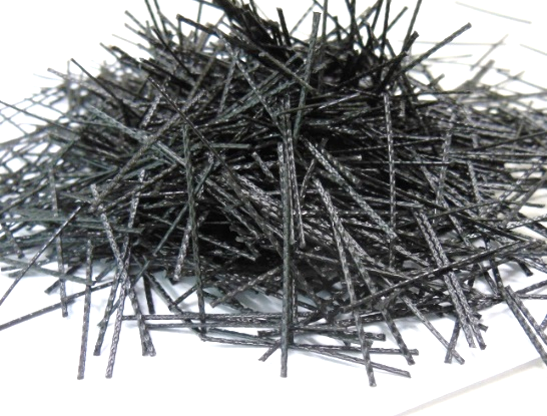
【AmiChip】
Strategic Rationale
Addressing Structural Challenges in Plastic Recycling
Despite increasing regulatory pressure and investor focus on sustainability, material recycling of plastics remains limited due to challenges in quality consistency, performance assurance, and stable feedstock supply. As a result, a substantial portion of waste plastics continues to be processed via thermal recycling, leading to ongoing CO₂ emissions.
In response, Hagihara Industries and its partners have developed AmiChip, a recycled PP short fiber containing more than 50% recycled content, while maintaining mechanical performance comparable to conventional virgin-based products and meeting applicable JIS standards.
This development directly addresses a key bottleneck in circular materials adoption: the trade-off between sustainability and performance.
Product Overview: AmiChip
AmiChip is manufactured using an original formulation that combines:
- High-tensile window screen offcuts generated at Daiwa House Industry’s factories
- Recycled materials with superior spinnability
- Virgin PP materials supplied by BarChip Inc. to ensure consistent quality
By integrating these inputs, the product achieves:
- >50% recycled material content
- Tensile strength and spinnability equivalent to conventional PP short fibers
- Compatibility with existing concrete reinforcement standards and applications
From a supply-chain perspective, Daiwa House Industry operates eight factories nationwide, generating approximately 2 metric tons of homogeneous window screen offcuts annually, providing a stable and traceable recycled feedstock stream—an essential requirement for scalable material recycling.
At this volume, the recycled material can support the production of approximately 2,500 m³ of fiber-reinforced concrete, demonstrating clear potential for industrial-scale deployment.
Environmental Impact and Carbon Reduction
AmiChip contributes meaningfully to decarbonization across the construction value chain.
- Compared to conventional PP short fibers, AmiChip reduces CO₂ emissions by approximately 740 kg per metric ton of product, primarily through reduced virgin material usage.
- Transitioning 2 metric tons of window screen offcuts from thermal recycling to material recycling results in an estimated 8.1 metric tons of CO₂ emissions avoided.
- This reduction is equivalent to the annual CO₂ absorption of approximately 580 mature (50-year-old) Japanese cedar trees.
These reductions directly support Scope 3 emissions mitigation for construction companies and align with global ESG frameworks increasingly emphasized by institutional investors.
Construction Innovation: The MakuChip Method
To further accelerate adoption, Daiwa House Industry and Fujita developed the MakuChip Method, a surface application technique for PP short fibers.
Key Advantages
- Eliminates the need for mixer truck fiber blending, removing post-placement drum cleaning operations
- Reduces on-site labor and operational downtime
- Lowers fiber consumption by reinforcing only the surface layer, where cracking is most likely to occur
- Maintains crack control performance comparable to conventional mixing methods
Fibers are sprinkled onto freshly placed concrete using a dedicated spreading device and embedded via tamping before finishing. This approach improves productivity while lowering total material and operational costs.
The MakuChip Method was first implemented at Fujita’s Technical Center Annex “Tsuzuku”, completed on September 30, 2025, demonstrating real-world feasibility.
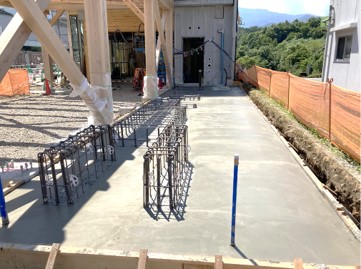
【Fujita’s Technical Center Annex “Tsuzuku”】
Commercialization and Growth Outlook
Following verification within Daiwa House Group construction projects, Kansai Chemical Industry will lead commercialization, sales, and distribution efforts.
From an investor perspective, this initiative offers:
- Expansion into high-value sustainable construction materials
- Strong alignment with ESG-driven procurement trends
- A replicable model for closed-loop material recycling
- Potential for long-term margin stability through differentiated, value-added products
Hagihara Industries and its partners remain committed to advancing circular economy technologies and strengthening material recycling capabilities as part of the Company’s long-term growth strategy.